Welcome!
The Economics of Social-Ecological Systems (EconSES) is one of the four research themes of the Environmental Economics and Natural Resources Group (ENR) at Wageningen University & Research.
Across the globe, social-ecological systems such as marine environments, forests, semi-arid grazing lands and fisheries are under increasing pressure from climate change, overexploitation and other stressors. At the same time, there are notable success stories, where resources are managed sustainably or where conservation has led to ecosystem restoration. Understanding why some systems are sustainably managed while others are trapped in a state of overexploitation is at the heart of our work. Human behavior and nature shape each other, and whether a system is used sustainably depends on the institutions that couple them: formal institutions such as protected areas and property regimes, and informal arrangements such as communal social norms. Ecological tipping points make these traps hard to escape: once a system has shifted into a degraded state, it may stay there. Yet social tipping points can also open windows of opportunity for institutional change, pushing a system towards recovery.
Our research combines economic theory, empirical analysis and interdisciplinary collaboration to understand the complex dynamics of social-ecological systems, addressing questions such as:
- Which institutions and policies enable sustainable resource use and ecosystem restoration?
- What are the costs and benefits of alternative policy options and pathways, and who are the winners and losers?
- How can we balance resilient ecosystems, livelihoods and income within a safe and just operating space?
- When does better information, for example about the value of ecosystems, lead to better decisions?
Curious about our work? Dive into our projects and publications, and please reach out to us.
Research Domains
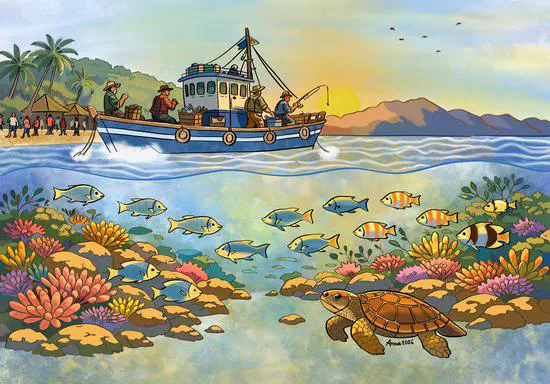
Marine Systems
We study the interactions between fisheries, marine ecosystems, and coastal communities to inform sustainable ocean management and marine conservation policies.

Ecosystem Restoration
We analyze how restoration policies and nature-based solutions can recover ecosystems while delivering benefits for biodiversity, climate mitigation, and society.
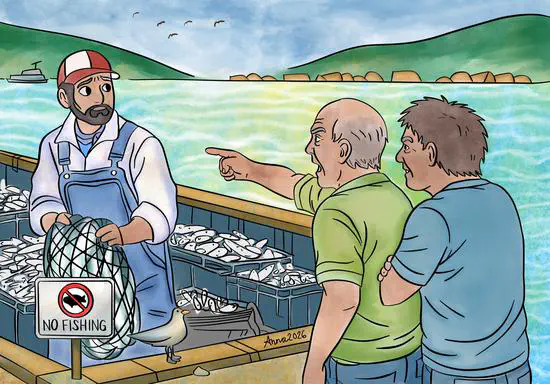
Behavior in the Commons
We study how individual behavior, social norms, and institutions shape cooperation and resource use in shared natural resource systems and common-pool resources.