Self-governance of Water Resources Under Climate Change: Insights from Cambodia
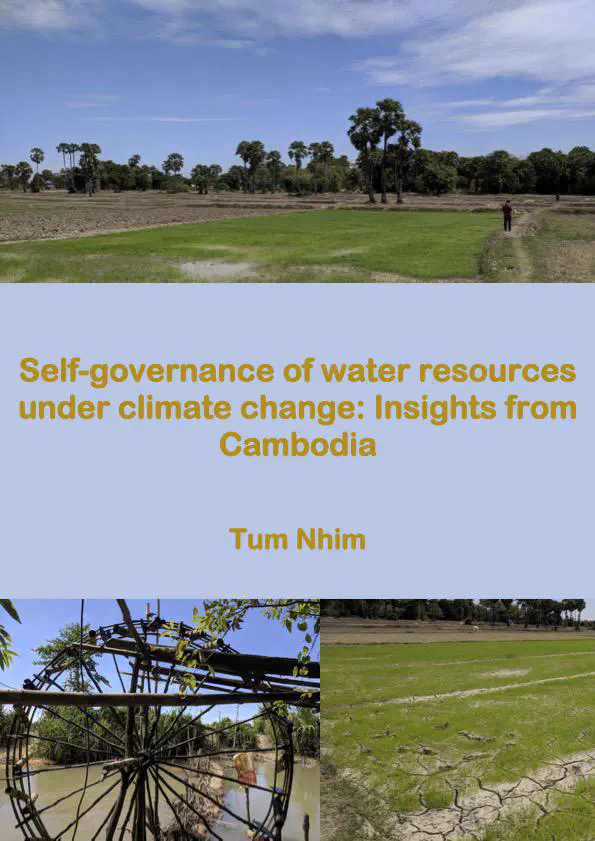
Tum's dissertation examines how small-scale irrigation systems function as social-ecological systems and how cooperation among water users can be sustained under the pressures of climate change. Combining evolutionary agent-based models with lab-in-the-field experiments in Cambodia, Tum explores how resource scarcity, inequality, and institutional arrangements influence collective action in managing water resources and maintaining irrigation infrastructure. The findings show that scarcity can undermine cooperation, especially when social capital and peer enforcement are weak, potentially leading to institutional traps in which poor cooperation reinforces resource scarcity. At the same time, strong social capital, reputation mechanisms, and effective governance institutions can support cooperation and help communities overcome these challenges. Overall, Tum's dissertation highlights the complex interactions between environmental conditions, social structures, and institutional design in shaping the sustainability of irrigation systems.

Tum Nhim
Tum’s research focuses on collective action in social-ecological systems, particularly how institutions, cooperation, and resource scarcity shape the governance of common-pool resources.