FishTech: The Impact of New Technologies on Fisheries Management
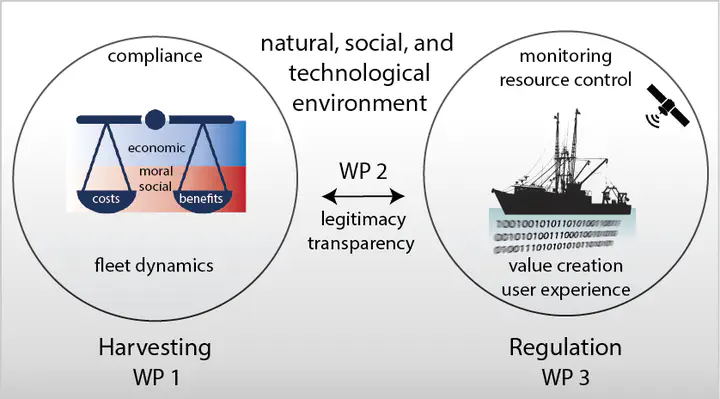 FishTech project structure: harvesting (WP1), legitimacy and transparency (WP2) and regulation (WP3), embedded in the natural, social and technological environment.
FishTech (Research Council of Norway, 2018–2025) asked a simple question: if cameras, satellites and electronic logbooks can watch every haul, do fishers actually comply more? The project started from the idea that technology changes behaviour through incentives, norms and the perceived legitimacy of rules, rather than through monitoring alone. Combining surveys, economic experiments, modelling and large-scale logbook data, it studied how new technologies affect compliance and fleet dynamics, how monitoring interacts with fairness, participation and the legitimacy of regulation, and how new technologies can be harnessed to design more effective management and create more value from marine resources.

Andries Richter
Associate Professor
My research focuses on the economics of social–ecological systems, using theoretical models, causal empirical methods, and economic experiments to understand how institutions and human behavior affect the sustainable management of natural resources.